
中

In 2026, the iPSC therapy will achieve a historic breakthrough.
In March 2026, the Ministry of Health, Labour and Welfare of Japan (MHLW) conditionally approved the world's first two iPSC-derived cell therapy products - Amchepry (for Parkinson's disease) and ReHeart (for heart failure). From the time Shinya Yamanaka's team discovered iPSCs in 2006 to the approval of the first product for market launch in 2026, this was a 20-year scientific marathon that finally witnessed the historic leap from the laboratory to the pharmacy.
This is not only a milestone in regenerative medicine, but also marks a fundamental shift in the human treatment model from "using drugs to control symptoms" to "replacing and repairing with cells".
Parkinson's disease: The most intense "raceway" in iPSC clinical applications
Parkinson's disease (PD) is one of the fastest-growing and most competitive indications in the clinical development of iPSCs. There are multiple pipelines in clinical stages worldwide, resulting in a competitive situation among China, Japan, the United States, and Europe, with diverse technological routes.
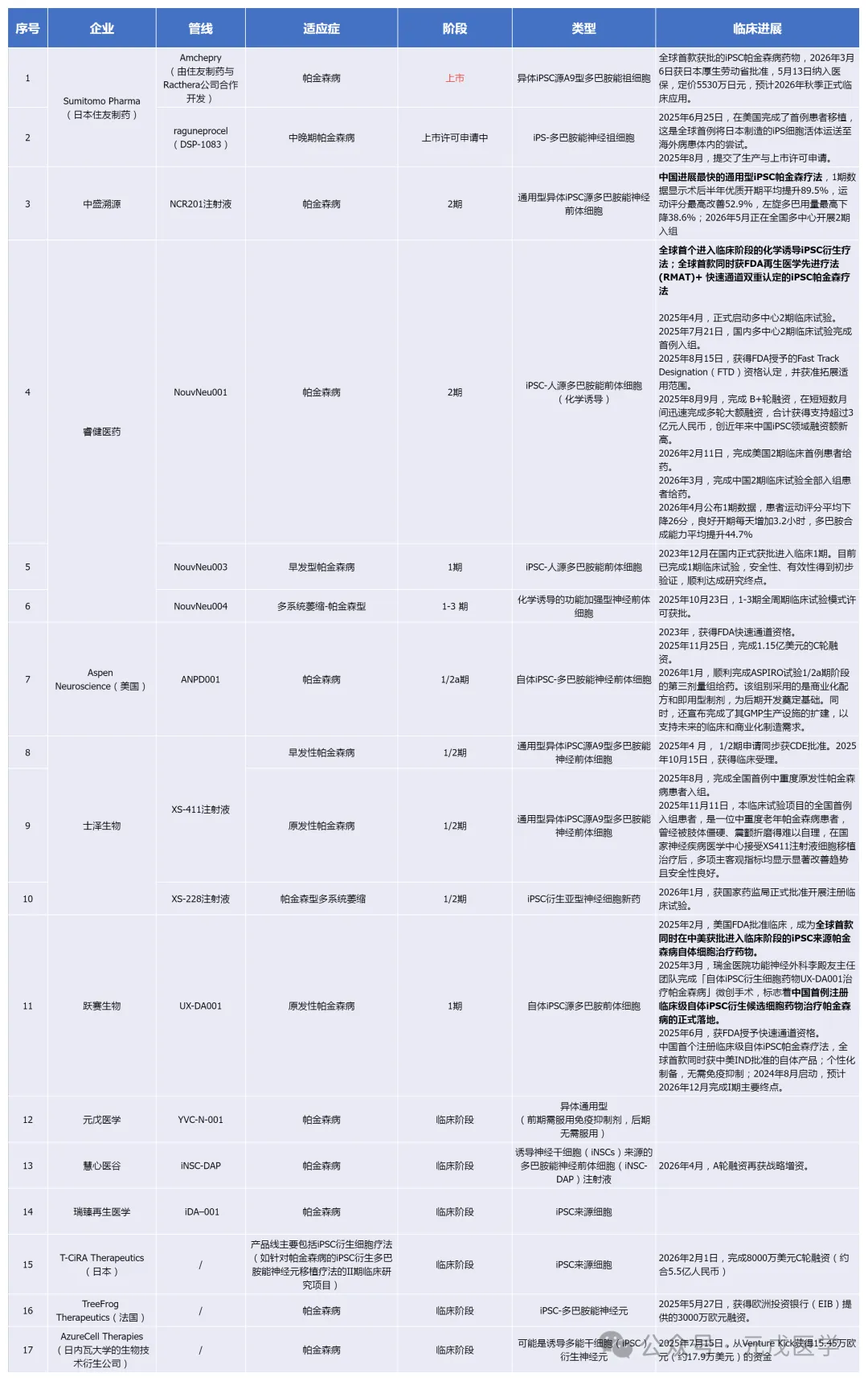
The iPSC therapy for Parkinson's disease has developed into three major technical routes:
① Allogeneic universal type (现货型): Represented by Amchepry, NCR201, and XS-411, this approach utilizes HLA-matched iPSC libraries or gene editing to reduce immune rejection. Patients do not need to wait for individualized preparation and can quickly receive treatment. This is currently the fastest clinical advancement and has the most clear commercial prospects among the routes.
② Autologous individualized therapy: Represented by ANPD001 and UX-DA001, it involves reprogramming of the patient's own cells. Theoretically, there is no immune rejection, but the preparation process is long (lasting from several months to half a year) and the cost is high. It is suitable for patient groups with sensitivity to immunosuppression.
③ Chemical induction of iPSC: Represented by NouvNeu001, Ruijian Medicine's unique chemical small molecule reprogramming technology avoids the risk of genome integration caused by traditional viral vectors. It is the world's first chemical-induced iPSC-derived therapy to enter clinical trials and has received dual recognition from the US FDA's RMAT and Fast Track programs.
Chinese enterprises have performed particularly well in the field of Parkinson's disease iPSCs:
Ruijian Medicine NouvNeu001: The world's first chemical-induced iPSC therapy, submitted for approval in both China and the United States. The Phase I data is excellent (the motor score decreased by 26 points), and the Phase II progress is advancing rapidly.
Zhongsheng Xuanxi NCR201: The fastest-growing universal iPSC-based Parkinson's therapy in China. The data from the first patient's 3-month follow-up is positive (a 26-point decrease in UPDRS III), and the second phase of national multi-center enrollment is underway.
Shize Biotech XS-411: Universal allogeneic iPSC-A9 cells, showing significant improvement in the postoperative condition of the first severe and moderate patients
Yuesai Biotech UX-DA001: China's First Registered Clinical-grade Autologous iPSC Parkinson's Disease Therapy, Approved in Both China and the United States
Arthritis: The Next Boom Point of iPSC Regenerative Medicine
Rheumatoid arthritis and osteoarthritis are new fields that iPSC regenerative medicine is rapidly expanding into. Traditional treatments rely on immunosuppressants and biological agents, which can control symptoms but cannot reverse joint damage, and have significant side effects when used for a long time. iPSC-derived cell therapy provides a new treatment paradigm for refractory patients by achieving local immune regulation and tissue repair.
Rheumatoid arthritis (RA) is a chronic autoimmune disease characterized by synovitis of the joints and cartilage destruction. In advanced stages, patients suffer from joint deformity and loss of function. Current treatments are ineffective against structural damage.
Huweihengyuan's hiSC cell injection is the world's first clinical-stage product derived from iPSCs for Sertoli cell therapy. It employs a unique in vitro induction technology developed by Tsinghua University to directly differentiate iPSCs into Sertoli cells with immune exemption functions.
By injecting hiSC cells locally at the inflammatory site, the abnormal immune microenvironment of the affected joint is reconstructed through the natural immune exemption regulatory function of Sertoli cells. This therapy acts only on the local inflammatory site and does not interfere with the normal immune system throughout the body, fundamentally avoiding the systemic side effects of traditional immunosuppressants.
Osteoarthritis (OA) is the most common degenerative joint disease worldwide and is known as the "incurable cancer". Traditional treatments mainly focus on pain relief and joint replacement, but they cannot reverse the damage to the cartilage.
Compared with traditional autologous fat or bone marrow-derived MSCs, iPSC-MSCs possess irreplaceable technical advantages:
Cartilage regeneration ability: iPSC-MSCs can be directed to differentiate into mature chondrocytes, secrete chondrogenic-specific matrix, and directly repair damaged articular cartilage tissues, achieving structural repair.
Paracrine effect: By secreting various growth factors such as TGF-β, IGF-1, and anti-inflammatory factors like IL-10, it promotes endogenous cartilage repair and improves the microenvironment of the joint.
Immune regulation effect: Inhibits the release of pro-inflammatory factors such as IL-1β and TNF-α, regulates the transformation of macrophage phenotype, alleviates local inflammatory responses in the joints, and blocks the vicious cycle of disease progression.
Industrialization advantages: Through the cell bank, standardized and large-scale production can be achieved, solving the problems of insufficient donors and unstable quality of traditional adult MSCs, and possessing the potential for large-scale commercial application.
CYP-004 is the world's first iPSC-derived cell therapy product for osteoarthritis to advance to phase 3 clinical trials. In November 2023, 321 patients were enrolled, and the final follow-up visit was completed by the end of 2025. The results were announced in the second quarter of 2026, making it the world's most advanced iMSC-OA pipeline.
NCR100 is the first iPSC-derived MSC cell therapy product approved for clinical trials in China. The 2nd phase clinical trial has completed the enrollment of all subjects. In the 1st phase clinical trial, clear signs of cartilage growth were observed, indicating the significant potential of iPSC-MSCs in promoting cartilage repair.
The innovation of Yuanwu Medical's YVC-I-001 lies in using iPSCs through a unique neural crest cell differentiation pathway to induce mesenchymal stem cells (i-MSCs) that are more suitable for cartilage regeneration. Its core patent effectively avoids the risks such as abnormal ossification and cartilage hypertrophy that may occur in traditional cell therapies, aiming to achieve "structural repair" of joint cartilage and providing a new technical path for the complete cure of osteoarthritis.
Diabetes: The "Functional Cure" Path of iPSC Regenerative Medicine
Diabetes, especially type 1 and refractory type 2 diabetes, are traditionally treated with lifelong insulin injections or oral hypoglycemic drugs, which cannot be cured and have severe complications. The iPSC-derived pancreatic islet cell replacement therapy, by recreating functional pancreatic islet tissues in vitro and transplanting them into patients, has the potential to achieve autonomous regulation of blood sugar and bring new hope of "functional cure" to diabetes patients.
China has made a globally leading breakthrough in the field of chemical induction of iPSC pancreatic cells.
The team led by Shen Zhongyang and Wang Shushen from Tianjin First Central Hospital completed the world's first case of chemical reprogramming iPSC islet transplantation. The first patient achieved complete insulin independence 75 days after the transplantation. During the 365-day follow-up, the glycated hemoglobin remained consistently below 6.0%, and no tumor signs were observed. This achievement was also selected as one of the top ten papers of 2024 by Nature and one of the best papers by Cell. It was also cited in the 2025 edition of "Chinese Diabetes Prevention and Treatment Guidelines", marking that China has taken the lead in the global field of chemical reprogramming iPSC technology.
Ripchenchuang is also actively promoting the clinical transformation of chemically-induced iPSC pancreatic cells. RGB-5088 is the world's first self-renewal pancreatic islet product to enter the clinical stage. It is prepared using the patient's own cells, fundamentally avoiding immune rejection reactions, and does not require long-term use of immunosuppressants, making it safer.
Zhixinhaozheng Allogeneic Human Regenerative Pancreatic Islet Injection (E-islet01) is the first allogeneic universal regenerative pancreatic islet product to be approved for clinical trials in China. It has also received IND approval from both the China CDE and the US FDA. In March 2026, this team, in collaboration with Shanghai Changzheng Hospital, completed the world's first minimally invasive transplantation of autologous and allogeneic stem cell-derived regenerative pancreatic islets, achieving the reconstruction of pancreatic islet function and autonomous blood sugar regulation in patients with type 1 diabetes. The related results were published in the international top journal "The Lancet Diabetes & Endocrinology".
In addition, many Chinese enterprises such as Xing Sairen and others are also actively establishing their presence in the iPSC islet cell sector, covering various indications including type 1 and type 2 diabetes, and have formed a complete industrial ecosystem.
Summary
In 2026, iPSC therapy officially moved from a scientific concept to clinical reality. The approvals of Amchepry and ReHeart were not only a tribute to the 20-year scientific exploration of Shinya Yamanaka's team, but also announced to the world that cell replacement therapy is no longer a distant future, but a medical revolution that is happening right now.
From helping Parkinson's disease patients regain their mobility, to bringing hope for cartilage regeneration in patients with osteoarthritis, iPSC technology is demonstrating revolutionary potential in multiple difficult-to-treat disease areas.
Of course, this is just the beginning. Issues such as long-term efficacy, safety, cost control and regulatory coordination still require continuous exploration by the industry. But it is certain that the "cell-based drugs" era of regenerative medicine has officially arrived.